
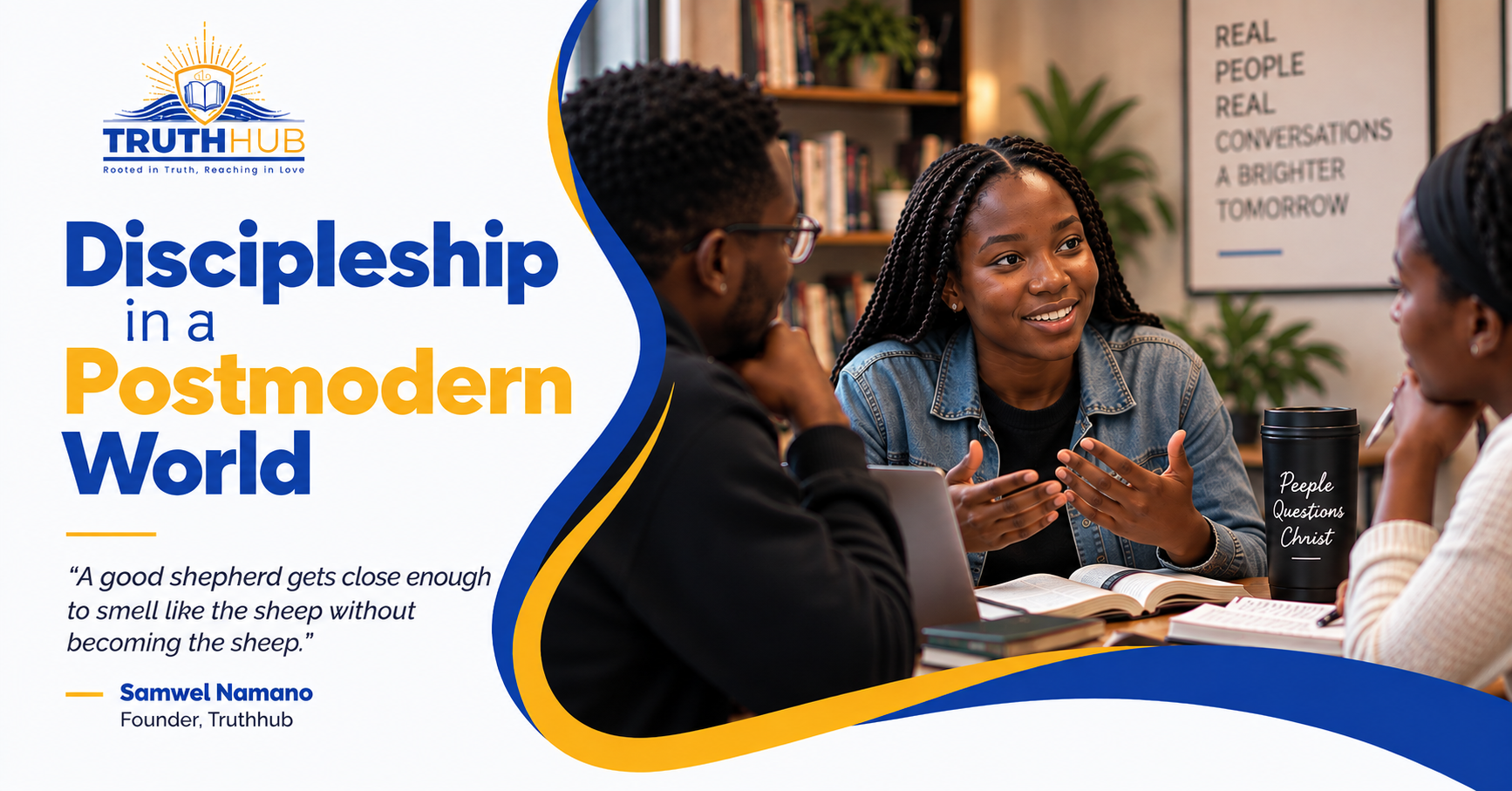
Discipleship in a Postmodern World
Jesus left the Church with a clear commission:
“Go and make disciples of all nations, baptising them and teaching them to obey everything I have commanded you.” Matthew 28:19–20
The Great Commission has not changed. But the world in which we are fulfilling it has.
We are no longer discipling people in an environment where Christianity is the only voice speaking. We are discipling people while hundreds of competing voices are discipling them simultaneously.
Culture is speaking. Social media is speaking. Friends are speaking. Universities are speaking. Influencers are speaking. Algorithms are speaking. Every day, people are being presented with different definitions of truth, identity, freedom, sexuality, success, happiness and the good life.
This means that our approach to discipleship must go beyond asking, “What should we teach?”
We must also ask:
How do we form men and women whose relationship with Christ is deep enough, whose understanding of Scripture is strong enough, whose community is healthy enough, and whose worldview is grounded enough to follow Jesus faithfully in a culture constantly offering alternative versions of truth, identity and the good life?
The Gospel Has Not Changed, but the Context Has
The Apostle Paul gives us an important example.
When Paul entered different communities, he did not change the gospel to make it acceptable. But he understood the people he was speaking to and communicated the unchanging truth of Christ within their context.
In Athens, for example, Paul observed the culture, understood what the people believed and even engaged ideas that were familiar to them before pointing them to the true God they did not yet know.
That is contextualisation.
The gospel remains true and unchanging. But the way we communicate that gospel must take seriously the generation standing before us.
This means moving from only telling people what Christians believe to helping them understand why we believe it.
It means moving from only preaching to creating spaces for honest conversations.
It means moving from events to intentional relationships with Kingdom impact.
It means moving from judging people from a distance to getting close enough to understand their questions, fears, wounds and worldviews.
And ultimately, it means moving from simply creating followers to making disciple makers.
The Shepherd Must Get Close Enough to Smell Like the Sheep
There is a thin line between contextualising the gospel and compromising it.
Perhaps the picture of a shepherd helps us understand the difference.
A shepherd does not become a sheep by shepherding them. But a good shepherd gets close enough to smell like the sheep.
A good shepherd does not shepherd from a distance.
He walks among the sheep. He understands them. He stays close to them. He knows when they are wounded, when they are wandering and when they are afraid.
In the same way, effective discipleship in a postmodern world requires proximity.
We cannot disciple a generation we refuse to understand.
We cannot reach people whose questions we are unwilling to hear.
We cannot expect people to trust us when our first response to their worldview is condemnation rather than conversation.
Getting close does not mean becoming like the culture. Understanding someone's worldview does not mean adopting it. Loving someone does not require compromising biblical truth.
Jesus demonstrated that perfectly. He could come remarkably close to people whose lives were far from God without becoming like them. His holiness did not create distance from broken people. Instead, His holiness, truth and love drew them toward transformation.
That should challenge our discipleship today.
We Must Be Willing to Leave Our Comfort Zones
Discipleship in this generation will require us to move beyond the safety of our Christian circles.
We must be willing to sit with people whose worldviews are completely different from ours.
To listen before answering.
To understand before judging.
To build relationships before demanding trust.
To answer difficult questions without becoming defensive.
To demonstrate the gospel, not merely explain it.
And through genuine love, biblical truth and the work of the Holy Spirit, point people toward Christ.
The goal is not to make the gospel comfortable.
The goal is to make the gospel clear.
Our methods may change. Our language may change. Our platforms may change. The questions each generation asks may change.
But Christ does not change.
The challenge before us, therefore, is not simply to preserve the message for the next generation. It is to faithfully carry that message into their world.
So perhaps every disciple maker, pastor, ministry leader and Christian should ask:
Do I know the people I am trying to disciple?
Do I understand the voices shaping them?
Have I created room for their difficult questions?
Am I close enough to understand their world without compromising the truth of Christ?
The Great Commission still stands.
The question is whether we are willing to get close enough, listen deeply enough, love genuinely enough and teach faithfully enough to make disciples who will stand firm in this generation and go on to disciple the next.
The gospel remains unchanged. But faithful discipleship requires us to understand the world into which we have been sent.
Related Articles

0 Comments
Be the first to share your thoughts.